Matthews left frustrated after ‘clear gap’ on caught behind review: Controversy mars T20 World Cup clash
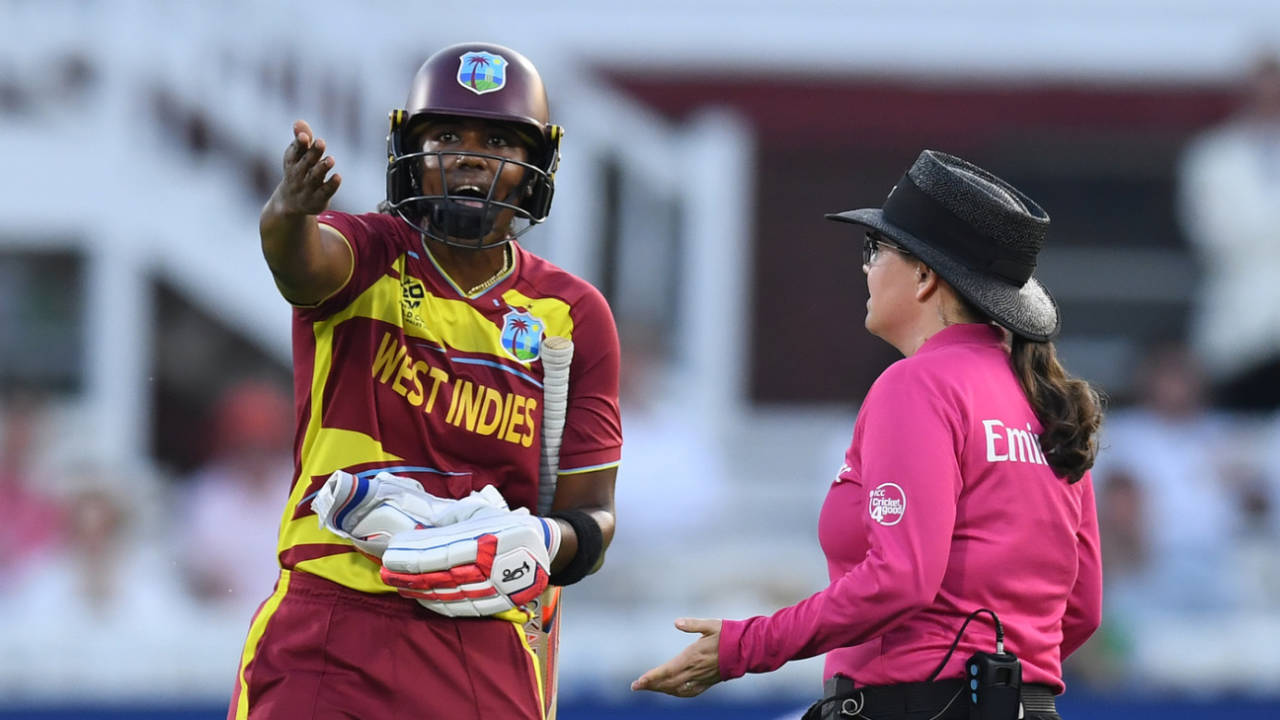
In a contentious moment that has sparked widespread debate across the cricketing world, West Indies captain Hayley Matthews found herself at the centre of a controversial Decision Review System (DRS) call during her team’s 38-run defeat to England in the T20 World Cup. The incident, which occurred at Lord’s, saw Matthews given out caught behind despite compelling visual evidence suggesting a clear gap between her bat and the ball. Matthews vehemently maintained that she did not make contact with the ball, adding another layer of frustration to an already challenging chase for the West Indies.
The Controversial Dismissal Unpacked
The pivotal moment unfolded in the fourth over of West Indies’ chase. England wicketkeeper Amy Jones appealed for an edge as Matthews attempted a cut shot off the bowling of Linsey Smith. On-field umpire N Janani initially remained unmoved, leading England’s stand-in captain Charlie Dean to signal for a review. What followed was a sequence of events that highlighted the complexities and occasional ambiguities of modern cricketing technology.
Initial video replays broadcast did not show any definitive deflection off the bat, though the ball certainly passed in close proximity. The television umpire, Nimali Perera, proceeded to utilise UltraEdge technology. This system subsequently displayed a spike, which typically indicates contact between bat and ball. However, a significant point of contention arose when, on the very frame where the UltraEdge spike was visible, the front-on replay clearly depicted a discernible gap between Matthews’ bat and the ball.
Umpire Perera acknowledged this apparent gap in the visual evidence and meticulously continued to review the available information. For several tense moments, Matthews awaited her fate, her frustration palpable. Ultimately, Perera concluded that despite the visual discrepancy, there was sufficient evidence from the UltraEdge spike to confirm contact, advising the on-field umpires to reverse their original ‘not out’ decision.
Matthews’ Vehement Disagreement and Post-Match Remarks
The decision was met with immediate and strong disapproval from Hayley Matthews. She remonstrated with on-field umpires Janani and Eloise Sheridan before departing the field, her displeasure evident. Her frustration continued on the sidelines, where she was observed re-watching the dismissal alongside head coach Shane Deitz on the West Indies bench. Later, she was seen engaging in a discussion with reserve umpire Kerrin Klaaste outside the boundary’s edge, clearly seeking further clarification or expressing her dismay.
Post-match, Matthews reiterated her conviction that she had not hit the ball. She speculated that the noise detected might have originated from a different source. “When she cut at the ball, she heard something which she thought was probably her bat handle or something like that, and she immediately went to the on-field umpires and told them that she heard a noise,” Matthews explained in her post-match press conference. “She certainly felt like she was far away from the ball, and she let them know what the case was, but the third umpire obviously has a decision to make.”
“She felt like you could have seen a clear gap between bat and ball, but at the same time, [the TV umpire] has got to work with the technology that there is, and she saw a spike, and at the end of the day, she’s going to have to respect that,” Matthews conceded, albeit with a clear underlying tone of dissatisfaction regarding the process and outcome.
The commentary team during the host broadcast also noted the absence of any discernible noise on the stump microphone at the time of the incident, further adding to the layers of doubt surrounding the decision.
Technology Under the Spotlight: A Recurring Debate
Hayley Matthews’ dismissal is not an isolated incident; it serves as the latest flashpoint in an ongoing debate surrounding the accuracy and interpretation of edge detection technology in cricket. Similar controversies plagued the ‘Snicko’ system during the 2025-26 Men’s Ashes series, where several decisions based on technology were heavily scrutinised and widely debated. These incidents highlight the inherent challenges in relying solely on technological output when visual evidence presents a contradictory narrative. The human element of interpretation, even with advanced tools, remains crucial, and moments like these raise questions about the threshold of “clear and obvious error” required for overturning on-field decisions.
Matthews’ Form and Team Resilience
Beyond the contentious DRS call, Matthews’ recent batting form has also been a talking point. After an impressive 48 in West Indies’ opening victory against New Zealand, her subsequent scores have been modest: 14 off 22 against Scotland, 17 off 17 against Sri Lanka, and another 14 off 17 against England. Matthews openly acknowledged her need to contribute more with the bat. “She needs to get some runs,” she stated, adding, “Deandra [Dottin] probably feels like she hasn’t been at her best either, and yet they’re still winning games, they’re still competing.”
Despite individual struggles from key players like Matthews and Deandra Dottin, the West Indies team has shown commendable resilience. Matthews views this as a positive sign for the squad’s depth and collective strength. “She thinks it’s a really good sign because at one time they would probably struggle to win a lot of these games without herself or Deandra performing really well,” she explained. “The fact that she’s been struggling, Dottin has been struggling, Chinelle [Henry] has only really gotten a score in today. When they’re still in the position they are, it shows that they’ve got a lot more people that they’re relying on now.” This demonstrates a maturing team dynamic, where the reliance is spread across multiple performers rather than concentrated on a few star players, bolstering their chances in crucial tournaments.
West Indies’ Path to the Semi-Finals
Despite the defeat to England, West Indies maintain a strong position in Group 2, currently holding second place with three wins from four matches. Hosts England have already secured their spot in the semi-finals, leaving West Indies in strong contention for the remaining qualification spot. A victory for West Indies in their final group match against Ireland on Saturday would unequivocally confirm their progression to the last four. However, a defeat would open the door for both New Zealand and Sri Lanka to potentially overtake West Indies on net run rate, should they secure victories in their respective final fixtures. The stakes are incredibly high, and while the controversial dismissal of Matthews remains a talking point, the team’s focus will undoubtedly be on securing that crucial win against Ireland to ensure their T20 World Cup journey continues.