Suthar announces his arrival with pinpoint control and sharp turn
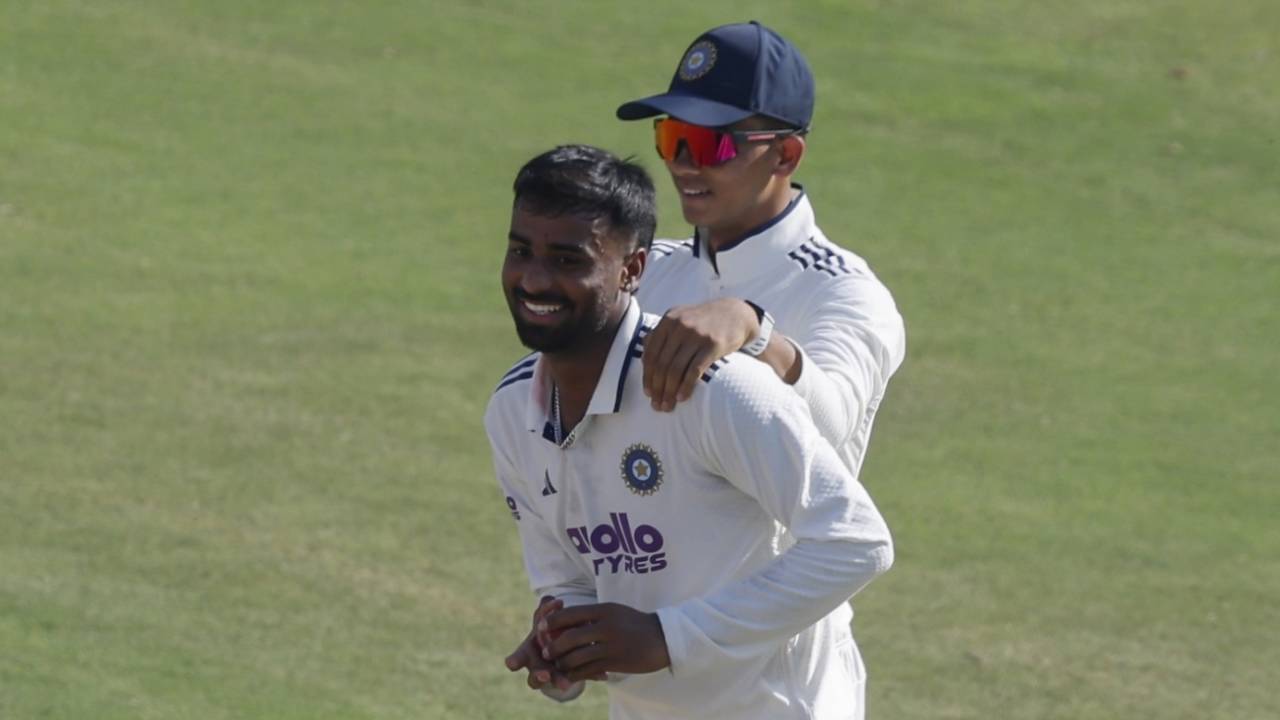
A Historic Debut in New Chandigarh
It was the final over before the tea break on the second day of the one-off Test match between India and Afghanistan in New Chandigarh. India had recently declared their massive first innings at 564 for 8, and Afghanistan’s openers had raced to a promising 28 for no loss within just five overs. In the pressure-cooker environment of Test match cricket, the moments leading up to a session break are always critical. With India searching for a breakthrough, captain Shubman Gill turned to debutant left-arm spinner Manav Suthar.
For nearly a decade, this specific role of bowling the high-pressure overs before a break was dominated by Ravichandran Ashwin. Whether by default or strategic choice, Ashwin’s tactical masterclasses and vast array of variations made him the ideal candidate to outfox defensive batters. However, with Ashwin retired and Ravindra Jadeja rested for this match, India fielded a relatively inexperienced spin attack. Together, the chosen spinners possessed only 112 Test wickets—the lowest for an Indian home Test since 2001. Facing right-handed opener Abdul Malik, Gill chose the debutant Suthar, trusting his ability to spin the ball away from the right-hander.
The Mechanics of a Traditional Left-Arm Spinner
While Suthar grew up studying Ashwin’s legendary variations, his style of bowling is distinctly traditional. He prioritizes metronomic accuracy over a flurry of variations. Approaching the crease from around the wicket, Suthar runs diagonally between the umpire and the stumps. This classic, albeit unfashionable, approach helps left-arm orthodox spinners remain side-on during their delivery stride. This alignment prevents the front arm from falling across the line of sight, allowing Suthar to maintain constant visual contact with the batter and make split-second adjustments.
Despite the ball being relatively new, Suthar showed no signs of hesitation. His extensive domestic experience prepared him well; in his 52 previous first-class innings, Suthar had shared the new ball nine times and bowled as the first-change bowler on 13 occasions. Operating at a natural speed of around 90kph, he delivered his first ball on a full length outside off-stump. It gripped and turned sharply right away. Malik stepped forward to defend but was completely beaten. The subsequent two deliveries followed a similar trajectory, spinning past the bat. Malik managed to stay inside the line, but Suthar had already established complete control over the battle.
A Dream Start: Wicket in the First Over
Under mounting pressure to survive the final three balls of the session, Malik attempted a sweep. Suthar, reading the batsman’s intent, pulled his length back slightly into a good length. The adjustment generated extra bounce, catching the top edge of Malik’s bat. The ball ballooned toward short fine leg, where Mohammed Siraj completed a comfortable catch. In his very first over of Test cricket, Suthar had claimed a wicket—becoming only the eighth Indian bowler in history to achieve this rare feat.
Post-Tea Dominance and Tactical Mastery
The tea break did nothing to break Suthar’s rhythm. He continued to choke the Afghanistan batting line-up with impeccable discipline. His control was so suffocating that Afghanistan’s batters managed to score off only three deliveries in his opening eight overs. Despite a slow pitch that offered little assistance in carrying edges to the slip cordon, Suthar kept creating opportunities.
When Suthar squared up Rahmanullah Gurbaz, the resulting edge fell short of first slip due to the slow nature of the surface. To counter this, skipper Shubman Gill adapted. Wearing a helmet, Gill moved closer to the bat at second slip and dropped to his knees. Though another edge fell frustratingly short, Suthar’s persistence eventually paid off. Gurbaz’s luck ran out when he edged another delivery to Sai Sudharsan at second slip, handing Suthar his second wicket of the day.
Afghanistan’s captain, Hashmatullah Shahidi, tried twice to disrupt Suthar’s length by charging down the wicket, but both attempts resulted in miscued shots toward short midwicket. When Rahmat Shah, technically the visitors’ most sound batter, attempted a similar charge, Suthar proactively pulled his length back, forcing Shah into a defensive posture. Suthar nearly breached his defense with a subtle, quick arm ball that caught the batsman on the back foot.
Suthar’s opening spell ended with phenomenal figures of 13-6-20-2. After a brief four-over rest, he was recalled to bowl what would be the final over of the day. He struck once again. Afsar Zazai attempted a pull against a short-of-good-length delivery, but the sluggishness of the pitch worked in Suthar’s favor. Zazai was through his shot too early, resulting in a leading edge that popped straight back to Suthar for an easy return catch. Suthar concluded the day with remarkable figures of 3 for 21.
A Treat to Watch
Broadcasters revealed that Suthar was extracting an average of 5.3 degrees of turn during his opening spell, significantly higher than the 3.7 degrees achieved by Afghanistan’s top spinner, Malik. His performance drew high praise from his teammates. Washington Sundar, who bowled in tandem with Suthar, described watching him as a “genuine treat.” Washington highlighted Suthar’s physical commitment, noting how he utilizes his entire body and pours his full energy into the load-up position for every delivery.
Beyond his bowling masterclass, Suthar also demonstrated his potential as a handy lower-order batsman. He and Washington compiled a vital 54-run partnership for the seventh wicket, with Suthar contributing an aggressive 28 off 41 balls. He showed no fear, stepping out of his crease to hit Shahidi for two boundaries and two magnificent sixes over long-on.
This batting display was no fluke. Suthar has been working diligently on his batting, scoring his maiden first-class century during the 2025-26 Ranji Trophy season. Fittingly, he reached that milestone by stepping down the track to hit offspinner Mukul Negi for a six.
The Future of Indian Test Spin
Following his debut, the 23-year-old left-arm spinner took to Instagram to share his joy, reflecting on his childhood dream of representing India in Test cricket. With his outstanding control, physical application, and handy batting abilities, Suthar possesses all the attributes needed to succeed at the highest level for a long time.
Prior to the Test, India’s head coach Gautam Gambhir stated that the team was actively looking for a reliable fourth spinner for their upcoming two-Test series in Sri Lanka this August. With Ravindra Jadeja, Washington Sundar, and Kuldeep Yadav virtually locked in, Suthar’s brilliant performance in New Chandigarh has almost certainly secured him a ticket to Sri Lanka.