1983 World Cup Hero Kirti Azad Debunks Viral Fake Celebration Bill
An Iconic Victory Tainted by Misinformation
The 1983 Cricket World Cup remains the most significant milestone in Indian sporting history. Under the inspirational leadership of Kapil Dev, the Indian team achieved the impossible by defeating the invincible West Indies side at the iconic Lord’s Cricket Ground. Decades later, this legendary triumph continues to capture the imagination of fans. However, a recent viral social media post has sought to fabricate a narrative surrounding the team’s post-victory celebrations, prompting a swift rebuttal from those who were actually there.
The Viral Claim and Kirti Azad’s Intervention
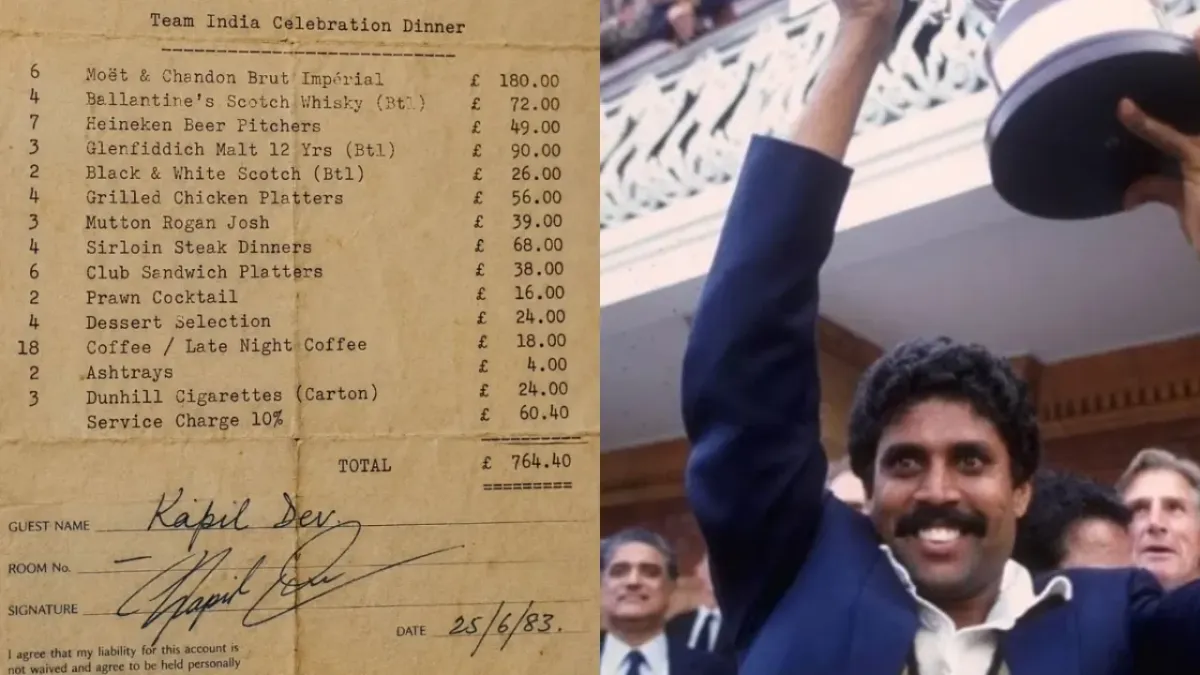
Recently, an image circulated widely on social media platforms, purporting to be a ‘Celebration Bill’ from the ‘Grosvenor Hotel.’ The document listed various alcoholic beverages and other expenses, totaling 764 British Pounds. Adding a veneer of authenticity to the claim was what appeared to be the signature of the then-Indian skipper, Kapil Dev. The document suggested that this was the tab run up by the victorious team following their final match.
Kirti Azad, a vital member of that historic 1983 squad, took to social media to firmly put these rumors to rest. Azad clarified that the entire document is an fabrication. He pointed out clear discrepancies that prove the bill is not legitimate, most notably the location of the team’s stay. Azad stated, ‘This is fake. It is all over social media. We stayed at Westmoreland Hotel, next to Lord’s Cricket Ground, London. After the victory on 25 June 1983, celebrations took place all night until the morning of 26th June. We never went to this hotel.’
Furthermore, Azad explicitly addressed the forgery, noting that the signature attributed to the legendary Kapil Dev does not match the captain’s actual handwriting. Former Indian spinner Laxman Sivaramakrishnan also chimed in to support Azad’s claims, adding, ‘Kapil Dev doesn’t sign that way,’ effectively debunking the authenticity of the viral image.
The Journey of ‘Kapil’s Devils’
The 1983 World Cup campaign was a rollercoaster that fundamentally changed the trajectory of cricket in India. The journey began in Manchester, where India stunned the world by beating the two-time defending champions, the West Indies, by 34 runs. This was followed by a victory against Zimbabwe, though the team faced a reality check with a heavy 162-run loss to Australia. The West Indies reclaimed their dominance in the following encounter, beating India by 66 runs, leaving the team at a crossroads.
It was during the second fixture against Zimbabwe that the tournament witnessed one of its most legendary performances. With the team in dire straits, captain Kapil Dev played an iconic, match-saving innings of 175 runs, single-handedly carrying India to a 31-run victory. This performance served as the catalyst for the team’s momentum. In the subsequent rematch against Australia, Madan Lal and Roger Binny dismantled the opposition, taking four wickets each to secure a massive 118-run win and confirm India’s place in the semi-finals.
Dominating the Knockout Stages
In the semi-final clash against England, the team showcased their collective resilience. Fifties from Yashpal Sharma and Sandeep Patil ensured a comfortable six-wicket victory, paving the way for a historic final at Lord’s. In the ultimate showdown, the odds were heavily stacked against India. Batting first, ‘Kapil’s Devils’ were bowled out for a modest 183, with Kris Srikkanth top-scoring with 38 and Sandeep Patil adding 27.
However, the Indian bowlers rose to the occasion with ferocious intensity. Defending a small target, they stifled the star-studded West Indian batting lineup, bowling them out for just 140. Mohinder Amarnath and Madan Lal were the stars of the bowling effort, claiming three wickets each to secure a historic victory that would redefine Indian cricket for generations to come. It is a legacy that rightfully belongs to the players, and as Kirti Azad’s intervention proves, the truth of their journey is far more compelling than any fabricated social media narrative.